
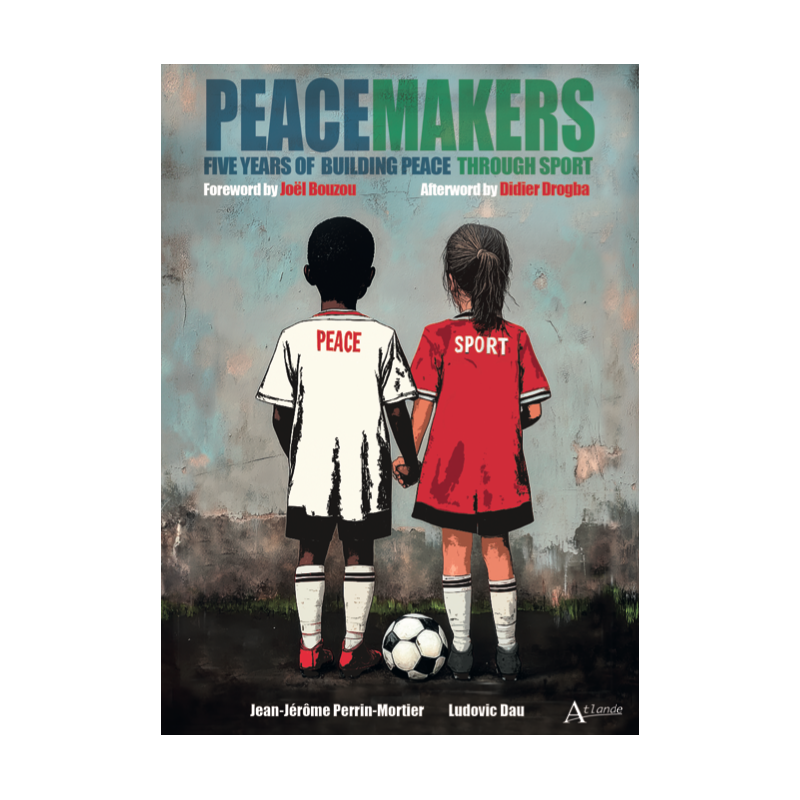
by Jean-Jérôme Perrin-Mortier and Ludovic Dau
 Livraison en lettre suivie
France met. : 5€ ⭢ 24€ d'achat, 10€ ⭢ 48€, 15€ ⭢ 96€, 20€ au-delà. DOM-TOM : 12€, 20€, 28€, 40€
For the last twenty years, Peace and Sport has worked to prevent violence, restore trust and favour reconciliation in countries hit by war, violence or tensions.
To quote its founder, the World Champion and Olympic medallist in modern pentathlon Joël Bouzou: “Because sport relies on shared rules, on shared experience and on fairness, it is ideal for teaching respect and cooperation. We must radically change attitudes: sport must explicitly be mobilised with a purpose, to empower present and coming generations with the values and life skills needed in order to reject all forms of violence and enable them to be resilient in the face of conflict.”
Thanks to the special position held by the Principality of Monaco on the international scene, Peace and Sport has managed to develop many initiatives in order to promote sport as a component of peace, such as its Forum, its Awards, its Ambassadors and the #WhiteCard campaign.
This progress report analyses some of the most striking outcomes of the past five years of the Organisation. Learning from its experience in Burundi and from its Live Together programme implemented in a refugee camp in Jordan, Peace and Sport has been rethinking its field activity during the Covid crisis. Three case studies in Togo, Colombia and India, all documented in association with Paris-Nanterre University, are the background for reassessing the Peacemakers Projects’ approach.
The book concludes with testimony from Didier Drogba, Vice-President of Peace and Sport, who reflects on his commitment to peace through sport.
Fiche technique
Foreword by Joël Bouzou 19
Introduction
A world under stress, a sector undergoing change 23
Peace through sport: when myth becomes reality 23
Peace and Sport: a unique pivotal player 24
A practitioner’s viewpoint: cross-cutting perspectives and lucid analyses 25
SDP: clarifying a field in tension 26
Capitalisation as an act of commitment 26
An invitation to collective responsibility 27
Peace and Sport: when myth becomes reality
Governance: an exceptional representation serving a universal vision 29
Monegasque neutrality: a foundation of legitimacy
and a tool for dialogue 30
The Peace and Sport Forum and Awards: rallying platforms 31
Champions for Peace: ambassadors for peace through sport 32
The #WhiteCard: a universal symbol 33
Strategic partnerships: spreading peace through sport 34
From the field to the institutions: a bottom-up approach 35
Conclusion: a unique model serving a global ambition 36
Sport for Development and Peace
Theoretical framework, scope and methods of action 39
An evolving international framework 39
Complementary areas of action 41
Sport: a cross-cutting driver for sustainable development 42
Methods of action 43
The ecosystem of peace through sport 45
International organisations 45
Institutional players 46
Sports governing bodies and event organisers 46
Civil society organisations and local communities 47
The athletes 48
Donors and the private sector 49
Academic institutions and research laboratories 50
Conclusion: challenges and opportunities 50
Rethinking sport for peace: field-tested
When the reality hits the ground: when the field reveals shortcomings and avenues for development 53
The faces of peace: Champions for Peace 54
Tegla Loroupe, a commitment to education 55
The dead end of vertical financing chains 56
Sport, an educational tool in search of credibility 56
Advocacy and symbolic commitment 57
Major issues facing the peace through sport sector 57
Systemic issues 57
Institutional issues 61
Operational issues 64
Optimising sport as a tool for peace 66
Systemic issues 66
Institutional issues 72
Operational issues 77
Conclusion: turning loopholes into levers 82
From the field to the Peacemakers Project: the cases of Burundi and the Zaatari refugee camp
Burundi: reconciliation through sport 85
When the reality hits the ground on the banks of the Tanganyika 85
The context of the programme 86
Programme phases 89
Learning: Burundi, a living laboratory of transformation 92
The “Live Together” programme 94
When the reality hits the ground: to the Zaatari camp and back 94
The context: the Zaatari refugee camp 96
The framework and origins of the programme 97
The coalition of players 98
The phases of the programme 100
Learning from the “Live Together” programme 102
Conclusion: learning from the field – structuring to amplify impact 108
Rethinking Peace and Sport’s action on the ground
Immersion: the post-Covid-19 turning point 111
Context: 2021 – laying the foundations for repositioning 112
Peace and Sport: structural advantages… 112
… And structural obstacles to development 113
Thinking together to act together 114
The Peacemakers Project: a grassroots response to international issues 115
Step 1: define 116
Step 2: design – global mentoring 119
Step 3: develop – tools for players in the field 120
Step 4: evaluate, improve and extend – a global experience with local dynamics 124
Three fields, three dynamics: shared experiences of the Peacemakers Project 125
Colombia: rebuilding social links and educating for peace through sport 126
India: sport as a lever for women’s emancipation 126
Togo: professionalising local players 127
Conclusion: an international spin-off with local roots 128
Evaluation for transformation: ways to maximise impact
Introduction: the myth of impact assessment 131
Deconstructing classic approaches to M&E in Sport for Development and Peace 131
The theory of change in sport for peace 132
The different forms of impact 132
Peace and Sport: promoting sport’s contribution to peace 136
Peace and Sport’s vision and positioning 136
Peace and Sport x Paris-Nanterre University Foundation partnership 139
Recommendations for implementing M&E 140
Main difficulties encountered 146
Proposed theory of change and impact measurement indicator 148
Construction of impact measurement indicator frameworks 148
Impact measurement indicators 150
New perspectives for the situated evaluation of SDP field programmes 157
Heterogeneous local contexts: no single indicator? 157
Proposing comparative local analyses: towards situated quantification? 158
Conclusion 159
Peacemakers Case Study: Togo
Togo: initial research context 163
Immersion in the field 163
Togo: a cradle of peace through sport 164
The Champion at the heart of the project – history of programmes in Togo 165
Choosing the first research context 169
Scientific study - Togo 2023-2024 170
Description of the country’s context 170
Presentation of the call for projects, associations and activities 173
Operational implementation of research 179
Difficulties encountered in fieldwork 180
Analysis of initial results 181
Prospects for peace through sport in Togo 189
Systemic issues 190
Institutional issues 193
Operational issues 194
Conclusion 196
Peacemakers Case Study: Usme, Colombia
Sport as a community landmark 199
Immersion in the field 199
Memory of place: the wounds and resilience of a region 200
Organisation at the heart of the community: COP Colombia 200
Gerson Florez: the Child of Peace 201
Colombia, a furious desire for peace… through sport 202
Scientific study 205
Description of the country context 205
Presentation of the association and its activities 209
The Peacemakers Project 210
Operational implementation of research 213
Difficulties encountered in fieldwork 214
Analysis of initial results 217
Perspectives for peace through sport: Colombia 221
Systemic issues 221
Institutional issues 224
Operational issues 225
Conclusion 228
Peacemakers Case Study: Nanhi Kali programme, India
Empowering girls through sport 231
When the reality hits the ground: Toofan Games or the storm of emotions 231
Memory of place: a changing country-continent 232
Young girls confronting traditions: playing to exist 232
The Naandi Foundation at the heart of the regions 232
Incorporating sport to educate in a different way 233
India, the most promising territory for research 235
Scientific study 237
Description of the country’s context 237
The Indian education system and the place of physical activities and sport 237
Presentation of the association and the Nanhi Kali programme 242
Significant regional differences in sport participation 244
Setting up research and presenting data 247
Difficulties encountered in fieldwork 249
Analysis of initial results 250
Prospects for peace through sport 270
Systemic issues 270
Institutional issues 273
Operational issues 276
Conclusion 279
Conclusion. Building lasting peace: lessons, responsibilities and prospects
Key lessons learned from those working in the field 281
Evaluating differently: overcoming the myth of impact 282
The ecosystem of peace through sport: strengthening coalitions 282
Peace and Sport’s stance: the Peace through Sport label 283
20 years of Peace and Sport: an invitation to collective responsibility 284
Afterword by Didier Drogba 285
Glossary 289
Acronyms 293
Jean-Jérôme Perrin-Mortier :
With more than twenty years in the high-performance sports industry, Jean-Jérôme has developed a strong expertise that bridges elite athletic performance and large-scale sports development. He coached at three Olympic Games on three different continents, which gave him a rare global understanding of what drives excellence at the highest level. After the Rio 2016 Games, he made a deliberate shift from pure performance to sport-driven social impact. He joined Peace and Sport and took on operational leadership as Field Director, where he built and deployed programs designed to transform communities. Since 2022, he has served as CEO, driving the organization’s strategy, strengthening governance, and expanding international influence.
Ludovic Dau :
Ludovic Dau is a sports and international relations professional with more than a decade of experience at the intersection of sport, diplomacy, and social impact. Currently serving as Impact and Sports Diplomacy Director at Peace and Sport, he leads international programs that use sport as a tool for education, social cohesion, and peacebuilding. His expertise includes international relations strategy, partnership development, capacity building, and the design of innovative peace-through-sport methodologies implemented across multiple continents. Prior to joining Peace and Sport, Ludovic developed strong expertise in sports marketing and partnership management through his work at Lagardère Sports. He managed high-profile partnerships involving major international brands, professional cycling teams, and global sporting events.
The beginning of the 21st century is marked by a superposition of crises that are profoundly redefining social and political balances. Fragmentation of societies, rising violence, forced displacement, persistent inequalities, institutional distrust: these dynamics intertwine to produce fragile environments where traditional peace-building mechanisms struggle to produce lasting effects.
Against this unstable backdrop, sport has gradually gained recognition on the international stage. Included in United Nations agendas, integrated into national strategies for social cohesion, it is now presented as a relevant lever for development and peace. This recognition is a real step forward. It has made it possible to broaden funding frameworks, structure networks of players and legitimise practices that were long seen as peripheral.
Yet this dynamic is accompanied by a persistent paradox. The more sport is invoked as a tool for peace, the more the question of its practical effectiveness arises. There is still a gap between the rhetoric and the operational reality. Global ambitions come up against local constraints. Media events are no guarantee of social transformation. Impact indicators remain heterogeneous. The Sport for Development and Peace (SDP) sector is making progress, but structural tensions remain.
by Jean-Jérôme Perrin-Mortier and Ludovic Dau